

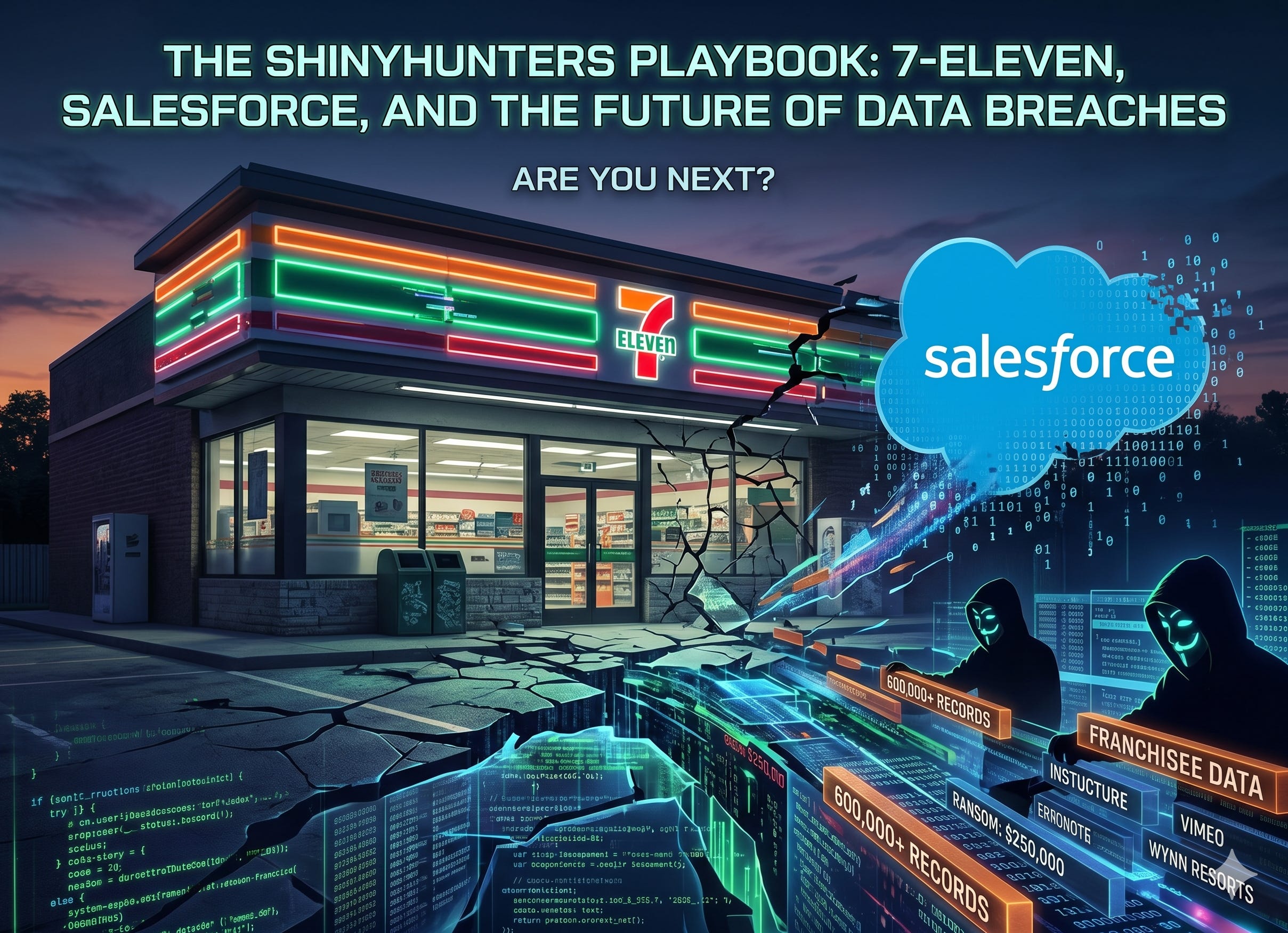
Over 600,000 Salesforce records. Franchise applicant data. A $250,000 ransom demand. That is the current state of the 7-Eleven breach, confirmed in May 2026, and it is another data point in a pattern that security teams can no longer afford to ignore.
What Actually Happened
7-Eleven, the world’s largest convenience store chain, confirmed a data breach after detecting unauthorized access to systems used to store franchisee documents on April 8, 2026. The company began notifying affected parties and filed a breach notification with the Maine Attorney General’s Office, acknowledging that personal information submitted during franchise applications had been compromised. The total number of affected individuals has not been disclosed publicly, though the Maine filing noted only two state residents were impacted, which suggests personal data exposure may be relatively contained.
That said, “limited personal data” does not mean limited breach. The scope of what was taken is the real story here.
The ShinyHunters Angle
ShinyHunters listed 7-Eleven on its leak site on April 17, claiming to have exfiltrated more than 600,000 Salesforce records containing both personal information and corporate data. The group set a ransom deadline of April 21. When that passed without a payment, they pivoted to a direct sale on a hacker forum, asking $250,000 for the dataset.
This is a textbook ShinyHunters playbook: breach, threaten, sell. The group has been systematically targeting Salesforce environments since mid-2025, pulling millions of records across multiple major organizations. The intrusions are not the result of zero-days in Salesforce’s core platform. According to SecurityWeek’s reporting, the attack vectors are phishing, abuse of third-party integrations, and misconfiguration errors.
That last category should concern every security team running a Salesforce instance. Misconfigurations are preventable. They are also embarrassingly common.
This Is Not an Isolated Event
It would be easy to treat this as a one-off retail breach. It is not. ShinyHunters and affiliated threat actors have confirmed attacks on a growing list of high-profile organizations in recent months.
Instructure, the company behind the Canvas educational platform, was hit and ultimately reached a deal with the hackers to delete stolen data. Vimeo confirmed user and customer data was taken. Wynn Resorts disclosed that approximately 21,000 employees were affected. Vercel, the company behind Next.js, was breached. Medtronic confirmed a hack after ShinyHunters threatened a data leak.
That is five confirmed victims across education, entertainment, hospitality, developer infrastructure, and medical devices. Now add a global convenience store franchise. The diversity of these targets tells you this is not a targeted campaign against one sector. It is an opportunistic sweep of organizations that share one common weakness: a poorly secured Salesforce environment.
Why Salesforce Keeps Showing Up in Breach Reports
Salesforce is not the vulnerability. That distinction matters. The problem is how organizations configure, integrate, and maintain access to their Salesforce instances over time.
Third-party integrations are a particularly high-risk surface. Many organizations connect Salesforce to other platforms using service accounts with excessive permissions, often set up years ago and never reviewed. A phishing email targeting one employee with access to one of those integrations can open a direct path into a data store containing hundreds of thousands of records.
Misconfiguration is the other major factor. Publicly accessible reports, guest user settings left enabled, sharing rules set too broadly, and stale OAuth tokens all create exposure that has nothing to do with Salesforce’s own security posture.
What a Proper Salesforce Security Review Looks Like
Any organization running Salesforce should treat this breach as a function to run through a few non-negotiable checks.
Start with the Health Check tool built into Salesforce. It scores your configuration against baseline security settings and flags deviations. It takes under an hour to run and costs nothing. There is no excuse for skipping it.
Audit connected apps and OAuth grants. Pull a list of every third-party integration currently authorized in your org. Remove anything that is no longer actively used. For those that remain, verify that permissions are scoped to the minimum required. Broad “full access” grants for integrations that only need to read contact records are a standing invitation.
Review guest user access and public site configurations. Guest users in Salesforce can access more data than most administrators realize, particularly if sharing rules have been modified without a full impact assessment.
Enable event monitoring if your license tier supports it. Suspicious bulk data exports, login anomalies, and API activity spikes are detectable if someone is watching. Attackers pulling 600,000 records do not do it silently.
The Bottom Line
ShinyHunters is running a repeatable, scalable operation against Salesforce environments across industries. The 7-Eleven breach is confirmation that no vertical is out of scope. The attack vector is not unique. Phishing, stale integrations, and misconfiguration are baseline security hygiene problems that have existed for years.
The organizations getting hit are not necessarily the ones with the worst security teams. They are the ones that allowed complexity and integration sprawl to outpace their visibility. That is a solvable problem, but it requires someone to own it proactively rather than waiting for a leak site posting to force the conversation.
Sources and Further Reading
7-Eleven breach confirmation and Maine AG filing: https://www.securityweek.com/7-eleven-data-breach-confirmed-after-shinyhunters-ransom-demand/
Maine Attorney General breach notification submission: https://www.maine.gov/agviewer/content/ag/985235c7-cb95-4be2-8792-a1252b4f8318/4fe778c0-a3a9-4dbe-8e79-2c229ac5c36b.html
ShinyHunters topic coverage at SecurityWeek: https://www.securityweek.com/topics/shinyhunters/
ShinyHunters Salesforce campaign targeting hundreds of organizations: https://www.securityweek.com/hundreds-of-salesforce-customers-allegedly-targeted-in-new-data-theft-campaign/
Instructure Canvas breach and data deletion deal: https://www.securityweek.com/deal-reached-with-hackers-to-delete-data-stolen-from-the-canvas-educational-platform/
Vimeo data breach confirmation: https://www.securityweek.com/vimeo-confirms-user-and-customer-data-breach/
Wynn Resorts breach affecting 21,000 employees: https://www.securityweek.com/wynn-resorts-says-21000-employees-affected-by-shinyhunters-hack/
Vercel breach: https://www.securityweek.com/next-js-creator-vercel-hacked/
Medtronic hack confirmation: https://www.securityweek.com/medtronic-hack-confirmed-after-shinyhunters-threatens-data-leak/